How to Play
- 1
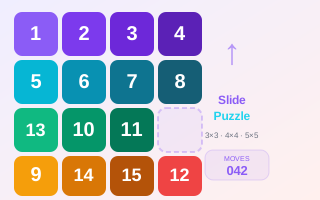
Click a tile adjacent to the empty space to slide it in.
- 2
Arrange all tiles in numerical order (1–15) to solve.
- 3
Choose 3×3, 4×4, or 5×5 grid size for varying difficulty.
- 4
Try to solve it in the fewest moves possible!
ℹ️About This Game
The sliding puzzle — best known as the "15 puzzle" — was invented by Noyes Chapman in 1874 and became a craze in 1880s America. The classic 4×4 version has 15 numbered tiles and one empty space. The goal is to restore the tiles to numerical order by sliding them one at a time. Mathematically, exactly half of all random configurations are unsolvable due to permutation parity. The 3×3 version (8-puzzle) is famous in computer science as a benchmark for search algorithms.
💡Tips & Strategy
- 1
Solve the top row first, then the second row, working your way down to leave the 2×2 bottom-right corner last.
- 2
Master the "rotation" technique to move tiles without disturbing already-solved sections.
- 3
For the last two tiles in a row, use a special 4-move cycle rather than trying to slot them directly.
- 4
The 3×3 version can always be solved in 31 moves or fewer — count your moves for efficiency.
❓FAQ
Q. Are all sliding puzzles solvable?
No. Exactly half of all random arrangements are unsolvable. We only generate solvable puzzles, so you can always find a solution.
Q. What sizes are available?
We offer 3×3 (8-puzzle), 4×4 (15-puzzle), and 5×5 (24-puzzle). Each larger size dramatically increases difficulty.
Q. Is there a fastest solution?
Yes — optimal solutions exist and are studied in computer science. For everyday play, focus on solving it at all rather than optimally.