How to Play
- 1
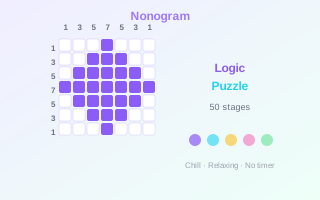
Numbers on the top and left show the lengths of filled blocks in each line.
- 2
Left-click to fill a cell, right-click to mark it empty (×).
- 3
There must be at least one gap between separate blocks.
- 4
Solve the grid to reveal a hidden pixel-art picture!
ℹ️About This Game
Nonograms — also called Picross, Griddlers, or Hanjie — are picture logic puzzles invented independently in Japan and the UK in the late 1980s. Each puzzle hides a pixel-art picture that you reveal by filling in the correct cells based on number clues. The clues tell you the lengths of consecutive filled blocks in each row and column. Nonograms were popularized in Japan by publisher Nikoli under the name "Nonograms" and became a beloved daily puzzle in newspapers worldwide, later inspiring Nintendo's Picross video game series.
💡Tips & Strategy
- 1
Start with the longest clues — a large block in a small row can only go in a few places, giving you guaranteed cells.
- 2
When a clue number equals the row length, fill the entire row. When it's half the row or more, you can fill the overlapping region.
- 3
Use × marks aggressively to mark cells that cannot be filled — it prevents mistakes as much as it helps progress.
- 4
Solve rows and columns alternately — progress on one often unlocks deductions on the other.
❓FAQ
Q. What are the numbers on the side and top?
They show the lengths of consecutive filled blocks in each row (left numbers) or column (top numbers). Multiple numbers mean multiple separate blocks, in order from top to bottom or left to right.
Q. Can I guess in Nonogram?
Pure nonograms are meant to be solved by logic alone. If you're guessing, there's usually a deduction you've missed. Try cross-referencing rows and columns more carefully.
Q. What size are the puzzles?
We offer puzzles from 5×5 (beginner) to 15×15 (expert). Larger grids reveal more detailed pixel-art images.